Sunday, 2 September 2012

"Pind" da Craft!

How are you? :)
It was a beautiful day in Alwar today! Raining in here..and Alwar is GORGEOUS during monsoons! :D
Today I am going to share my Punjab experience. It was my first trip ever to the "pinds" and was full of, well, confusions and discoveries, disappointments and adventures..but, all-in-all, quite memorable!
We went there on a ten day expedition to study the craft of "Punja Durrie". Punja Durrie is a handicraft which was traditionally practiced by the women of Punjab. "Punja" is a tool which plays the role of a "reed" in the weaving process of "durrie" i.e. carpet. Hence, the name.
This craft was a part of the legacy passed on from a mother to her daughter. Also, a particular number of these durries (woven with visuals having auspicious symbolism) were gifted by the mother to the daughter's in-laws as blessings for the newly weds.


This module called "Craft Cluster" mainly involved a detailed documentation of the craft and making of an audio-visual narrating a story related to the craft. It gave me the opportunity to try my hands on the craft of video making with the help of Premiere Pro. Our AV is based on the concept of  how the introduction of machine woven and other hand woven durries, which are faster and simpler, have led to the fall in the demand of "punja durries". The AV also shows the process of weaving.
I shall, in fact, upload the video pretty soon! :)
Till then the visuals will narrate the story. Allow them to give you an insight of the craft and how it works, looks and feels.
Punja, the tool used for beating of yarns after which the weaving process has been named.
Charkha used for spinning of cotton.
 Cotton yarns being dried before being wrapped onto the khaddi (loom frame) or dyed.

Khaddi with complete warping.
Artisan inserting the wefts in between the warps, incorporating the design.

 Bed durrie about to be completed.
Popular motifs.

Type of clipping (rarely done because its time taking and market demand is less).

Simple yet beautiful, isn't it? :)
However, due to magnitude of hard work required to weave the durrie and it's very low market demand, the craft is almost dead. The availability of cheaper and more durable options has led to a decline in its demand.
It was just over-whelming to see the artisans working SO hard to weave each one of it, enough to sensitize us towards this craft and many others..It's essential for all of  us to not just understand the value of these handicrafts which make our culture wealthy and meaningful, but also, contribute our bit towards its survival and more..

Saturday, 1 September 2012

My interpretation of "FEELING"

This is a project from the module of Visual and Design Culture in which any sculpture belonging to the modern era had to be picked out and analyzed as per one's own understanding.
This is the piece I chose.
"Feeling" by Kusum Jain


This sculpture is made out of fibre and was displayed at Triveni Gallery, Triveni Kala Sangam, New Delhi.
The sculpture has been given an ancient look with the base colour being golden with a tinge of black here and there. On seeing the sculpture, deliberately without looking at the title, i firstly tried to figure out what is it that the sculptor wants to get across to its viewers through this piece. The significant things which were visible in the sculptor were the woman, the children and the woman’s elongated legs and arms.
The woman shown is Indian, which is pretty much clear from the way the woman has tied her hair into a bun (jooda). Her body proportions have been made in a way which depicts her arms and legs longer than required.
After looking at the title “feeling”, I interpreted the woman as the mother of the children. The posture in which she is sitting is the one in which generally a parent plays with his/her kid. So the sculpture is showing the mother who is trying to enjoy with her children. The significant part is the elongated legs and arms which show the over-whelming love and care, the feelings; she has in her heart for the children that she can do anything to give them happiness. Not only has she been shown with longer legs to make it easy for all of her children to enjoy with her all together, but her longer arms depict that she’s vigilant about their safety as well. Also, since its quite a height for the small kids, she has been shown with a raised head so that she can keep an eye on them.
Another thing which the sculptor might be trying to show is the ethics of the Indian culture and the urge children have to get their parents’ blessings! Since all the small kids have been shown one after the other, we can interpret that they are having a race kind if a thing to see who reaches to the mother’s feet first to touch them and be blessed. Though, it’s more of just a fun activity and a mother’s feelings for her children are unbiased and unconditional! They are always equal for all her children no matter what!
Since the sculptor has shown so many children clung to the their mother’s legs, in a loving but playful manner, it also represents the idea, of the old India, of having many children who further go on to carry the family name and culture. Also, I feel that all the kids shown are males, which shows the stereotypical, yet still present tradition of preference of a boy child over a girl child.
By the title of the sculpture “feeling”, the whole concept of an infant recognising her mother through the tactile feel or the touch has also been reinforced by the artist. It’s that touch which makes an infant aware of his/her mother being around him/her and the child being absolutely safe and protected. So it’s the “feel” that connects an infant to his/her mother.
If we look at the colour of the art piece again, we can see the use of more of gold where the mother has been shown, while more of black towards the other end. This might be to show the extreme divinity, godliness and serenity of the motherhood!
Another thing which comes into my mind on seeing the shape and form of the sculpture is a saxophone. A saxophone being a musical instrument which, according to me, represents passion and intense emotions is an absolutely appropriate form to be given to the whole piece as the relationship between the mother and her children is very intense and strongly passionate too! Hence, this form can be justified.

"Metaphor for Delhi"

Hello people!
I have been discussing my college projects and the work I have done. This one is for a module named Design Methods in which we were asked to work in groups of five on a topic based on Delhi, which we chose as "Delhi Tourism". Now, since a large chunk of the module was based on this particular theme, it involved various activities of which I would be sharing the final outcomes.
The process involved lots of brainstorming, mind-mapping, secondary and primary research. One of the primary objectives was to symbolize Delhi as a metaphor. With the data collected and analysed, a few points which stood out were that Delhi, as a city, has various layers composed of people belonging to every strata, religion, mindset; as a city, it has significant structures, buildings and areas ranging from those built decades ago, to the ones which are very recent or are still getting built, every minute..every second..!
So, we first prepared a moodboard which highlights its attributes-
Evolution.Eclectic.Concentric
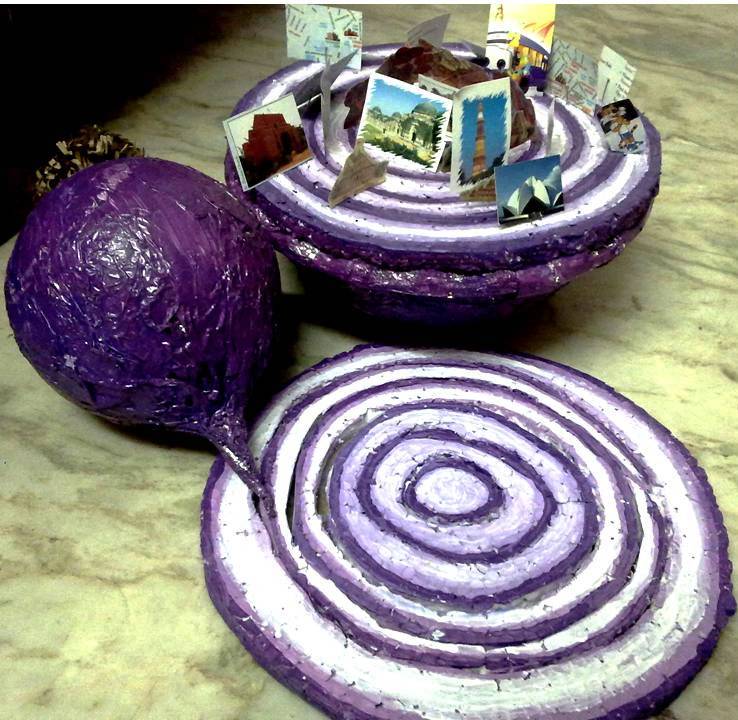
After that, we finally figured it out. We used a very regular, yet unique metaphor for Delhi..an ONION! Yes, an "onion", we felt, with all of it's goods and bads, represents THE DELHI. :)
Delhi has a history of 100 years and has progressed and developed with every reign of any dynasty, the rule of every invader, may it be Mughals, Mauryas, British etc. and now finally, the Indian Government!
Delhi has evolved from the seven cities near Qutub Minar, Siri, Tughlaqabad, Jahanpanam, Ferozabad, city around purana quila, Shahjahanabad and New Delhi. Most of us are very much familiar with the beauty of Delhi city which is visible in its modernity- the mall culture, highways, hotels and restaurants, clubs, pubs, huge buildings etc., but hardly anybody has seen or even knows about the deep cultural background and the deep-rooted history of the city. Well, if we go a little more deep, it can be said that Delhi, as a city, needs to be peeled off to get to its true inner beauty. It is shelling and layers of hidden history and glory, which to date is not forgotten but lies deep within. With each peeling off of a layer of Delhi one immerses deeper into its ever lasting nostalgic as well as modern city, art and cultural dimensions, food- from street to world, spirituality and religion, greenery and open spaces. Every sense is triggered with each layer.
So, just like an onion has an exterior layer which is hard and protective and inner layers which are softer and more tasteful, Delhi has an exterior layer of showy, shiny places which are newly constructed and thus, strong and attention- seeking; while, as we go deeper into the layers, the history gets deeper and the city gets older! And this is how we presented it- 


Different layers of onion with structures of different eras
Another product that we developed to talk further about it's attribute of "triggering all the five senses" is a coffee table book consisting of how the city of Delhi talks to each one of our five senses. Following are a few glimpses of it.


  • The Sensory Immersion
  • Sense of Hearing


  • Sense of Vision
  • Sense of Touch


  • Sense of Taste
  • Sense of Smell